
Trim Excess Carpet and Complete Installation
From How to Choose and Install Wool vs Synthetic Carpet Treads · Step 7 of 8 · Video by The Home Improvements Channel UK
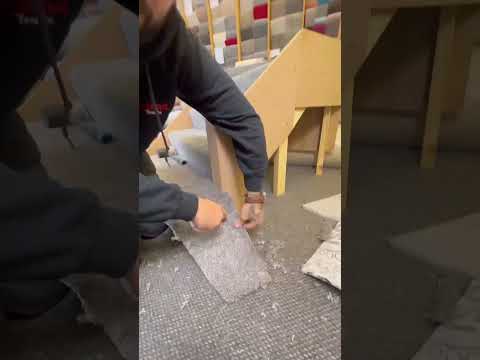
Showing 0:09–0:56 of the source video. Watch the full video with every moment.
What happens in this clip
To achieve a professional and tidy appearance, any excess carpet material extending beyond the desired dimensions of the stair must be trimmed. The installer uses a sharp utility knife or a dedicated carpet knife to make precise cuts along the edges of the stair, such as against the wall or banister posts. Additionally, scissors are seen being used for finer trimming of corners, irregular shapes, or to cut away any protective or backing materials (like bubble wrap). This step ensures that the carpet fits perfectly, eliminating frayed edges and providing a clean, finished look to the installed stairs. This entire process of positioning, securing, and trimming is then repeated for each subsequent stair until the entire staircase is carpeted.
Goal: Achieve a clean, professional finish for the stair carpet installation
What's used
Tools
- Carpet Scraper/Pry Tool
- Sturdy flat-head screwdriver
- Scissors
- cutting corners
- or removing protective packaging materials.
- Utility Knife
- Box cutter (with a very sharp blade)
Materials
- Stair Carpet
About the full video
This project provides a visual guide on how to install carpet on stairs, focusing on the practical steps of positioning, securing with staples, and trimming the carpet for a clean and professional finish on each stair. The video demonstrates the repetitive process required to uniformly carpet a staircase.
What's said in this clip
where I went wrong but I can write a song [Music] I don't think you're right for him now she be standing next to me [Music]
Automatically transcribed from the source video.
Step 7 of 8: Trim Excess Material
Once the treads are in place and the adhesive has begun to set, carefully inspect the edges. If there is any excess carpet material that extends beyond the stair tread, use a sharp utility knife or carpet shears to trim it neatly. Cut along the edge of the stair tread, ensuring a precise and clean line.
Every video in How to Choose and Install Wool vs Synthetic Carpet Treads
Step 1: Choose Carpet Tread Material
- 4:26–5:07 Understand Wool Rug Properties
- 0:37–0:54 Overview of Rug Materials
- 7:51–8:45 Choosing Rugs for Specific Rooms
Step 2: Measure Staircase Dimensions
- 0:00–0:03 Measure Individual Stair Components
- 0:57–1:16 Measure Treads and Mark Laminate
- 0:18–0:49 Measure Stair Tread and Riser
Step 3: Purchase Carpet Treads
- 0:02–0:04 Acquire and Prepare Carpet Treads
Step 4: Clean Stair Treads
- 0:34–0:40 Clean the Stairs
- 0:36–0:41 Clean and Smooth Stairs
- 0:09–0:45 Prepare and Clean Stair Treads
Step 5: Apply Adhesive
- 0:05–0:06 Apply Adhesive to Treads
- 0:34–0:46 Apply Carpet Adhesive to Stairs
- 0:59–2:07 Install First Stair Tread
Step 6: Install Carpet Treads
- 0:04–0:06 Install Carpet Treads
- 0:59–2:07 Install First Stair Tread
- 1:16–2:09 Install Carpet Treads with Adhesive
Step 7: Trim Excess Material
- 0:09–0:56 Trim Excess Carpet and Complete Installation (this video)
- 0:16–0:25 Trim Excess Carpet Along Edge
- 3:59–4:29 Final Trimming and Inspection
Step 8: Allow Adhesive to Cure
- 27:37–29:21 Curing and Final Reveal
- 3:44–4:26 Final Curing and Caulking
- 2:21–2:38 Complete Installation and Caulk Gaps
How to Choose and Install Wool vs Synthetic Carpet Treads
A high-level outline for choosing and installing carpet treads, covering material selection (wool vs. synthetic) and the installation process.
Read the full guide Browse all guides
Planning this project? Shop Oak Valley Designs.
Subscribe for exclusive updates
Be the first to know about promotions, new products, and sales.